
August 4, 2026
Hail-Damaged Vinyl Siding Needs More Than a Patch
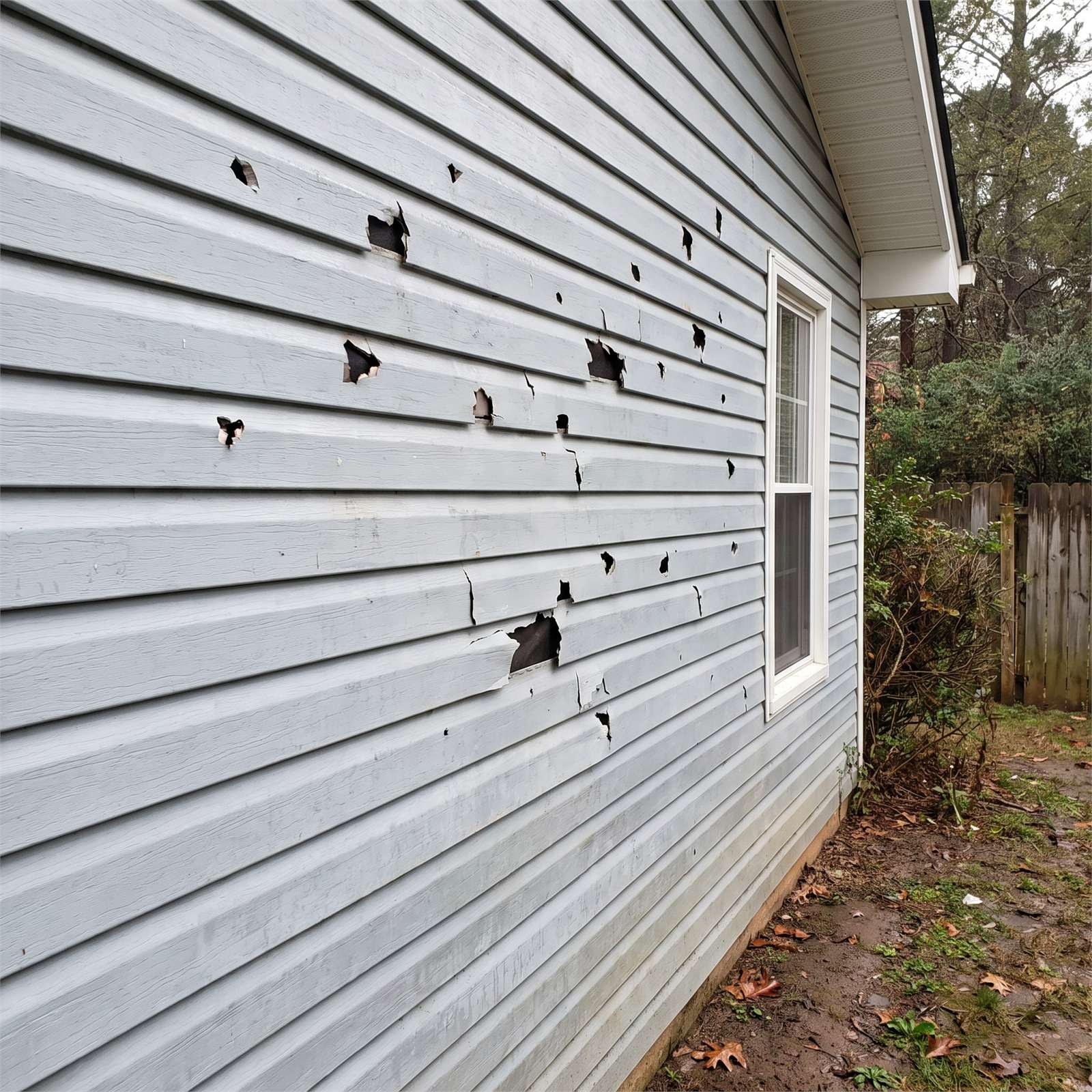
After recent severe weather, hail does not have to tear an entire wall apart to create a repair problem. On vinyl siding, large or wind-driven hail can leave scattered punctures, short cracks, and broken panel faces while the rest of the elevation still looks straight from the ground.
That mixed appearance is where claim scopes can separate. One estimate may count a handful of holes. Another may include full panel runs, corner trim, access work, and the labor needed to restore the wall as an assembly.
Start with the material that was actually hit
Vinyl siding is installed in overlapping horizontal courses. Each course locks to the one below it and moves with temperature changes. A qualified professional should inspect the wind-facing elevations, panel faces, lower locking edges, corners, window trim, and the shallow backing visible at any opening.
The inspection should distinguish impact breaks from fading, old cracks, heat distortion, lawn-equipment damage, and installation problems. It should also explain whether the affected profile, exposure, color, and interlock can still be sourced. A hole count alone does not answer those material questions.
Connect the inspection report to the reported weather
National Weather Service field photographs show what real hail damage to siding can look like: irregular holes and brittle broken edges spread across otherwise recognizable wall planes. The impact shapes vary. Intact siding remains between them. Window trim, soffits, and course lines still read as parts of one wall.
That visual pattern is useful context, but it is not proof of the cause at a different property. The professional inspection report should connect the observed elevation, impact direction, affected material, and date of loss to the available weather record. If the condition fits another cause, the report should say that plainly.
Read the contractor estimate and carrier scope together
The contractor estimate should identify the elevation, siding profile, measured wall area, openings, corners, trim, detach-and-reset work, disposal, and repair sequence. The carrier estimate shows which quantities and trades the insurer priced. The coverage letter explains the policy provisions and claim decision the carrier applied.
Those documents answer different questions:
- The inspection report explains what condition was found and where.
- The contractor estimate explains what work is required to remove and restore the affected assembly.
- The carrier estimate explains what work the insurer priced.
- The coverage letter explains the claim decision and the policy language cited for it.
If one document describes ten isolated holes and another describes a brittle, discontinued panel run, the difference is not just a price disagreement. It is a disagreement about the material and the repair method.
Access and sequencing can change the scope
Replacing a damaged siding course may require removing adjacent courses, corner posts, light blocks, shutters, or trim so the interlock can be released without creating new breaks. Work around windows and penetrations also has to preserve the wall’s water-shedding details.
A qualified exterior professional should explain that sequence in the repair scope. The report should also state whether a limited repair can be completed without cracking surrounding panels or leaving an incompatible profile. That is a construction question, not something a generic square-foot allowance can settle by itself.
The broader Georgia storm-and-hail claim guide explains how the reported cause, inspection findings, estimates, and policy decision fit together.
The homeowner consequence is a wall that still does not close correctly
If a scope prices only the visibly punctured pieces, the completed repair may still leave broken locks, mismatched courses, disturbed trim, or openings that were never included. If the siding is repairable with a small number of compatible panels, that matters too. Either conclusion should come from the material condition and repair sequence, not from assuming every mark requires the same answer.
Before the scope is treated as complete, the inspection report, contractor estimate, carrier estimate, and coverage letter should describe the same elevation, material, cause, quantities, and access work. When they do not, the first useful step is to identify the exact line where the descriptions separate.
This article provides general educational information. It does not determine coverage or replace a property-specific inspection, policy review, or repair assessment.