
July 25, 2026
Shallow Gutter Dents After Recent Storms: Hail or Something Else?
Small dents on a metal gutter can stand out after a storm, especially when sunlight hits the front of the gutter. Hail can leave dents, but so can a ladder, a branch, installation damage, or an older impact.
That is why a good inspection looks at more than one spot. A qualified professional should inspect the gutters, downspouts, roof vents, flashing, and other exposed metal to see whether the marks form a pattern that points to hail.
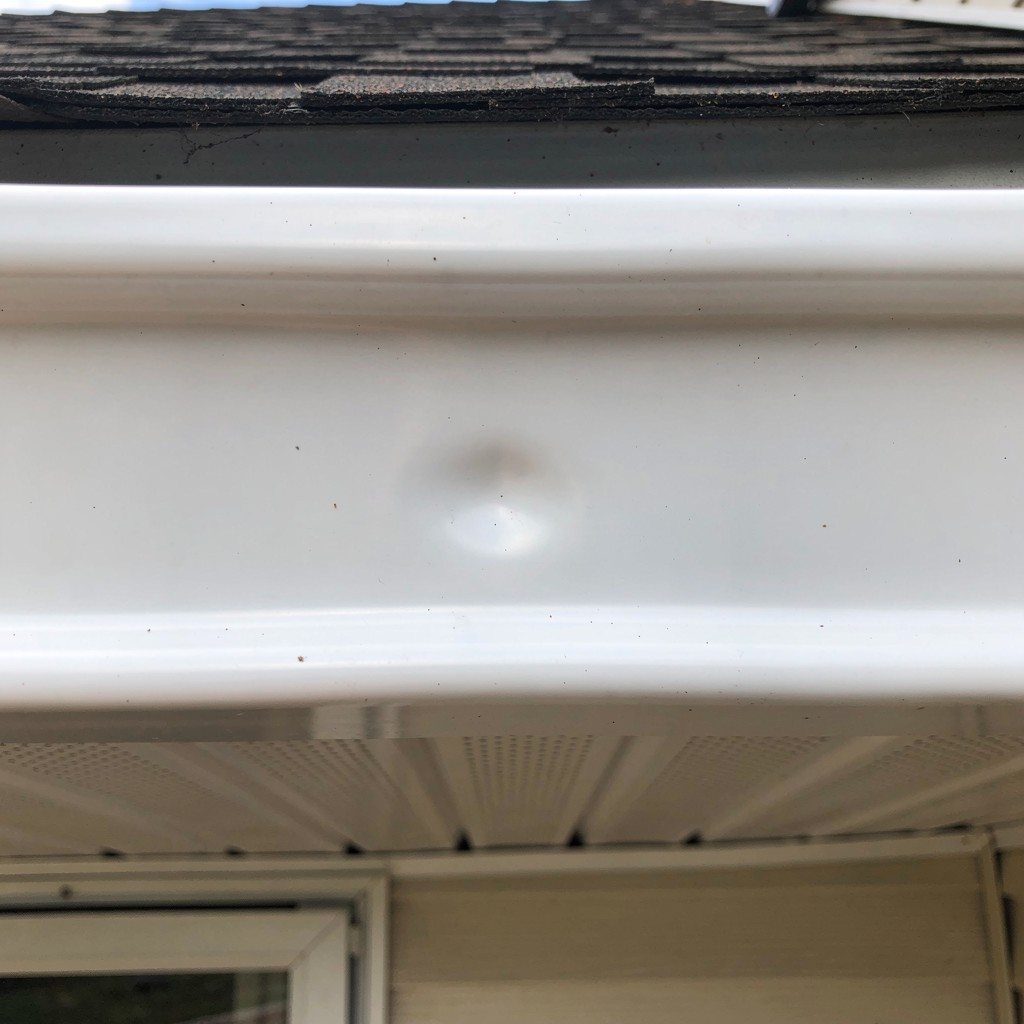
Look for a pattern, not a perfect match
Hail marks do not all look exactly alike. The shape can change with the angle of impact, the thickness of the metal, and whether the dent crosses a curved edge or seam.
A professional should look at:
- how many marks are present and how they are spaced
- whether similar marks appear on more than one side of the building
- the gutter face, bottom curve, top edge, seams, corners, and end caps
- downspouts, roof vents, flashing, trim, and other exposed metal
- scratches, creases, old repairs, oxidation, and other signs that point to a different cause
One dent may be worth a closer look, but the overall pattern is what helps explain what happened.
Check the gutter from end to end
The inspection should cover the full gutter, not just the easiest spot to see from the ground. Marks near hangers, seams, and corners can look different from marks on a flat section.
The professional should also check whether the gutter is straight, securely attached, and draining the way it should. A small cosmetic dent is different from a condition that affects alignment, seams, or water flow.
Compare other exposed metal
Roof vents, flashing, downspouts, and metal trim can provide useful context because they were exposed to the same weather. Similar marks across several components may support a storm-related pattern. A single isolated mark may point to something else.
Recent storms make a new concern worth checking, but they do not prove that every mark is storm damage. A careful inspection should leave room for ordinary wear, older impacts, installation damage, and the possibility that there is no meaningful storm damage.
For more context on exterior storm conditions, read Covenant’s Georgia storm and hail claim guide.
Decide whether a claim makes sense
A good inspection should give the homeowner a straightforward answer: what looks storm-related, what does not, and whether there is enough evidence to consider an insurance claim.
If the marks do not form a storm pattern, that is useful information too. It can keep a homeowner from making a claim based on a guess. If the pattern does point to storm damage, the findings can be compared with the policy, deductible, and repair scope before the homeowner decides what to do next.
Not every gutter dent is hail damage. A qualified professional should inspect the gutters and other exposed metal, explain what looks storm-related and what does not, and give the homeowner a clearer basis for deciding whether a claim makes sense.
Published by Covenant Claim Group LLC.
Matt Wilbur | Georgia Public Adjuster License #3033130